Wednesday, October 28, 2015

Shortage of minorities in engineering


USA TODAY did an analysis a couple of months ago showing that engineering firms reject Hispanic and black applicants twice as much in comparison to the rest of applicants. Engineering firms claim that the pool of applicants lacks of diversity and that the issue is beyond their reach. As a recent engineering graduate, I witnessed clearly that the amount of minorities in engineering are somewhat limited. But these claims are not sufficient. According to Fox News Latino more Hispanics are graduating college with bachelor’s degrees than ever before. As of 2014, Latinos accounted for 15% of STEM jobs (also known as Science, Technology, Engineering and Mathematics), it doesn’t seem as much but just 4 years ago Latinos constituted 7% of the population.

It is evident that technology is increasing exponentially, and it will continue to grow as technology becomes one of the main engines that drive our current economic market. This will lead to more openings in tech firms and companies are being pressured to diversify their market. Thus, we need to look closely at the root of this phenomenon. First, a considerable amount of minorities do not continue their education due to the lack of information, resources or even motivation which eliminates a large amount of potential engineers, mathematicians, etc. Furthermore, a large amount of minorities attends college but fails to finish their education. To exemplify this, the graph bellow shows a bar graphs portraying the percent of the population that finish high school, attend and finish college. In light brown we see that out of 19% of 18-24 year olds that are enrolled in college only 9% actually finishes their career (that is a 47% drop out rate) which is daunting.

There are many factors that contribute to this big dropout rate. Many of the young minorities have to work full time to sustain themselves while they attend college by working on fast food restaurant, clothing stores etc. Others get demotivated due to their minimal mentoring and orientation in earlier stages of their educational career leading to picking up vices and activities that could hinder their development.  There are many other factors but we will leave that to another discussion.

On the STEM side, this gets even more filtered because even fewer choose to pursue a degree in a STEM related fields. A study by the National Action Council for Minorities in Engineering, Inc. on U.S. engineering degrees found that African-Americans, American Indians, and Latinos account for 34 percent of the total U.S. population (ages 18 to 24), but earn only 12 percent of all undergraduate degrees in engineering. In fact, the share of engineering degrees earned by these three groups declines at higher educational levels: 12 percent bachelor's, 7 percent master's, and 3 percent doctorates. Meanwhile, women account for nearly half—46 percent—of the U.S. labor force but account for just 10.8 percent of U.S. engineers. This is a big issue because in order to remain competitive with the rest of the world we need to push for a progression of our education system and with that STEM related courses.

Consequently, one may argue that the shortage of engineers is due to the weak foundations that high schoolers receive as part of their basic education package. And yes, in part the government is responsible because of the lack of organization and the current curriculums in place despite the recent efforts of the commander in chief to include a higher load in STEM classes to prepare students in the near future. But also part of the problem could come from a lack of access. Data from the Department of Education's Office for Civil Rights showed African-American and Latino students are much less likely to have access to Advanced Placement courses in STEM fields. Many students also say they don't take AP courses due to a lack of confidence. 

The lack of diversity (and woman) in STEM jobs is evident but the complexity of the issue doesn’t end with the government being the solely faulty entity. The ratio of minorities STEM will not change unless we make a change from early stages. Perhaps there is a racial component linked to it, African-American and Hispanic STEM workers aren’t just lacking in the U.S., they also make up a relatively small portion of the foreign-born students and professionals in STEM in the United States. Currently, 63% of foreign-born STEM workers come from Asia, with most from India or China. But why? Perhaps a lot has to do with the culture itself. As a recent minority graduate in engineering I hope we make a change in the near future.


Friday, October 23, 2015

Elon Musk: the real life Tony Stark.

The South African inventor and CEO of Tesla Motors and SpaceX is unstoppable. Musk with degrees in Physics and a proven a electromechanical engineer is doing big things. He got introduced to computer programming at the age of 10 and at the age of 12 he sold his first code of a video game he created called Blastar for $500. After dropping out of the prestigious PhD physics program at Stanford he decides to go into the developing and changing the world with innovative ideas. The first one was called Zip2, a web software company providing business directories and maps to media companies and local e-commerce merchants that was sold to Compaq $307 million dollars in cash where Elon received $22 million from the sale. He then founded Paypal which was acquired by Ebay or US$1.5 billion in stock, of which US$165 million was given to Musk. Last but not least he founded SpaceX and Tesla motors, two companies that revolutionized the industry in their respective markets despite the initial years of losses on their financial statements.
Here are some of the stuff he is currently leading:

SpaceX

SpaceX has an end goal: to take people to space as soon as possible. With the recent funding cuts, government work and governmental companies like NASA are contracting companies like Space X and boy this work is lucrative. In May of 2005 SpaceX got a contract with NASA of over a billion dollar for Responsive Small Spacelift (RSS) launch services by the United States Air Force. Regardless of the money Mr. Musk has a different end goal. In an interview he stated he wanted to reduce the cost of space travel by a factor of 10, with a project to colonize mars in the near future. Musk reveals that he wishes to establish a Mars colony by 2040, with a population of 80,000 and that we need to start looking at other planets outside of Earth as a method of survival:

"An asteroid or a super volcano could destroy us, and we face risks the dinosaurs never saw: an engineered virus, inadvertent creation of a micro black hole, catastrophic global warming or some as-yet-unknown technology could spell the end of us. Humankind evolved over millions of years, but in the last sixty years atomic weaponry created the potential to extinguish ourselves. Sooner or later, we must expand life beyond this green and blue ball—or go extinct."
Tesla

They are the new thing, and everyone is talking about it. It is evident that the market for Tesla is hot and they are trying to keep up with the demand. According to Tesla’s website they are producing 550 cars per week and they tend to sell every single car. In fact, when going to the website you encounter a page that lets you reserve a car with a wait time of up to 6 months. Not all has been success for Tesla motors, currently they are still fighting against automobile dealers in multiple states because of the direct-to-customer approach that Tesla uses. In my opinion, the fact that automobile companies are lobbying against Tesla also serves as a propaganda to make the brand a little more exclusive and desirable. Tesla may lose sales in 5 states but gains recognition worldwide. It also gains recognition in the sense that it keeps bringing new things to the table. A clear example, is the tesla Model X, the first SUV that tesla produces. With ample seating up to 7 adults and an estimated mileage of 250 miles per charge model X promises to change the market. The price for the Model X has not been officially released yet but researchers of the market estimate it at nearly 100K. Many argue that Tesla’s are the future but that they are overpriced and only the wealthiest can get a hold of them. But wait, Musk is already working on that issue.

The Tesla Model 3 usually starts at $35,000 before any government incentives and deliveries are expected to begin early 2017. According to the website www.plugincars.com as of March 2015, the Tesla Model X is basically sold out. New orders submitted in spring 2015 will be fulfilled in “early 2016.” So, considering the lower price point, the number of hand-raisers for the Model 3 could create a long backlog—a nice problem for Tesla to have.


SolarCity

SolarCity is currently the second largest provider of solar panels in the United States. Although Elon Musk is the only chairman (not so bad for being the CEO of multiple companies) he made a commitment to make this smooth process for whoever wants to try the project. According to Lyndon and Peter Rive the current CEO’s their goal is to make this process super easy and accessible. You first get a free solar consultation where you will get a quote and study to determine whether or not your location will surplus the initial cost in 20 years. If so, you can go ahead and sign your agreement for the next 20 years where the guarantee no hidden fees along the way. Next, a solar panel system designer along with a surveyor come to your household and gather more information of the geolocation of the property. After, they start the installation where they claim to finish in one day (quite impressive), and they also take care of your permits and inspections. It seems like a solid plan in place, as long you have the right resources upfront.

Hyperloop

The need of a better way to mitigate traffic and transportation is evident here in California, especially in Los Angeles, and that’s where Elon Musk came with the idea of implementing a high speed transportation system driven by air compression and a specialized type of induction motor. In his plan he claims a hypothetical subsonic air travel machine that stretches approximately 350 miles (560 km) from Sylmar (a northern district of Los Angeles) to Hayward (east of San Francisco) and would theoretically allow commuters to travel between the cities in 35 minutes or less. This is huge impact in the way we see transportation since this is already faster than actual airplanes. This technology is barely being developed and is currently in the being discussed from a economic perspective. According to his proposal this will cost around 6 billion dollars. More concerns were raised (like getting sick at high velocities, unpleasant rides etc) when the proposal came up but his information and theory of the Hyperloop remains unproven. Currently no plan of development has been issued.

Elonk Musk with 44 years has done remarkable changes to society, and I am sure there will be more to come.


Saturday, October 17, 2015

Revolutionizing the cannabis industry

Lately the rise of Cannabis is evident. Cannabis serves the medicinal and recreational purposes. With more than 20 states having some kind of laws involving the decriminalization it is evident that the customer demand will continue to grow. More importantly, media has slowly merged the cannabis usage and the stigma is slowly disappearing. Until recently, marijuana and marijuana users were often associated with the word dangerous and negative. With all this, the business side of the cannabis looks promising because not only the demand of cannabis will increase as time progresses but also we will need to define and incorporate a social space for its consumption. In turn, this should lead to revolutionary entrepreneurs to incorporate this business into the defined social norms. Examples are bars, coffee shops, movie theaters, etc. and with the legalization of cannabis it would be plausible to incorporate cannabis into each industry. The end goal is for businesses to strengthen the cannabis industry and in doing so their own careers. Thus, I believe that the use of marijuana will be inevitable in the United States and there will be a need to incorporate new business models into already stablished businesses.

Why is it beneficial?

According to the PEW research center nearly 53% of Americans think that the drug should be legal in contrast with 44% who want it to be illegal. Interestingly only 4 states have legalized marijuana (Arizona, Colorado, Oregon & Alaska) and so far the implications of this motion looks promising when it comes to higher tax revenues. For example in Colorado, voters approved a 15% tax on the wholesaling of marijuana and 10% sales taxes on all recreational marijuana sales to the consumer. According to the Denver Business Journal, Colorado is expected to generate 60 to 70 million and that is just on the actual product not including other possible channels to make a revenue like marketing, distribution, supplemental products etc.

Those in favor suggest that those additional needs could be used for other basic needs in the community. Cris Miles, a journalist of mic.com in his blog he states:

“We've seen the economic power of legal pot. On January 1, when recreational weed became legally available to Colorado consumers, 24 pot shop owners across the state believe they collectively made more than $1 million in a single day of business. Residents can currently purchase up to an ounce of marijuana at one time for recreational purposes. Non-residents can purchase up to a quarter ounce. State officials expect up to $578,000,000 in first-year sales revenue, as well as $67 million in tax revenue, which will be used to build schools and fund regulatory efforts.”
So the question becomes, what are we waiting for?

Where is the entrepreneurship?  

Most of the numbers are solely based on the sale of the cannabis itself. A call to action is necessary for entrepreneurs to look closely at the way our society incorporates this product into their social settings. People looking into this business need to be able to forecast and innovate ways of incorporate cannabis into already stablished entertainment businesses as well as identifying their demographics of both current and future customers.

The once prohibited drug, Alcohol, can provide us with some business practices and history in regards to a newly introduced substance and more importantly how can this flourish under an excise tax. These new innovators need to look back and see what other industries did to remain open while living under times of crisis so they could get a better understanding in terms of maximizing resources and being innovative. A clear example was the national prohibition. National prohibition occurred January 1920 to December 1933, this law prohibited any beverage that contained 0.5 percent and higher alcohol content which killed about half the country’s distilleries and breweries, and perhaps 75 percent of the wineries according to John Ruch, a journalist from Georgia. So how did companies like Old Bushmills Distillery (also known as Jose Cuervo), Jack Daniels, Anheuser-Busch, amongst others survived. For once, they started to diversify their market, they started producing yeast and near-beer, but also ice cream, soft drinks, commercial refrigerators and car bodies. Only those companies with the capacity to develop sustainable business plans and the foresight into what the alcohol industry could be survived the prohibition era.


Even with the legalization of recreational marijuana, it is still illegal to consume in public space. For example, tourists visiting Colorado cannot consume marijuana in hotel rooms or similar settings. Regardless of this, entrepreneurs are looking into ways to create a safe place to participate in the activity. A different type of lounges have emerged around the globe. The website http://www.budpubs.com/ has a directory of locations where you can use the product and socialize. For example Space Lounge in Los Angeles California welcomes medical marijuana patients and offers a place to medicate. They have a dab bar and lounge with nice dab rigs, a good concentrate menu, 2 Big Screen TV and friendly atmosphere and offer free items to first time visitors. The Treehouse in LA found a way to comply with the law by making theirs establishment a “bring your own bud” business. They make profits by charging an entrance fee, supplying a variety of wraps, and rental fee for smoking apparatuses. This is where opportunity arises, entrepreneurs need to look at patterns and study where people chose to spend their free time. According to TIME magazines Americans average more than 3 hours watching TV and a portion of that is devoted to time spent in the movie theaters.  And this is where a group of young entrepreneurs are looking to incorporate cannabis.


Growing industry

At the University of Southern California Lloyd Grief Center for Entrepreneurship, a group of students is developing a business idea incorporating cannabis. The group is developing the first cannabis friendly movie theater. According to Johnny de La Cruz, a student majoring in entrepreneurship at USC, he stressed that the idea is innovative and with great chances of success. The group identified two important points about their idea. First, the movie theater industry in decline with a need of a boost and the need of a social place for cannabis consumption. This emergent business could solve some of the pains that each industry is facing. When asked about some of the challenges they spoke about licensing issues and some modification to the current buildings when it comes to movie theaters. They will venture this business in Colorado due to the current laws in California and they are already taking to mechanical engineers to modify the ventilation system to avoid irritability caused by smokers to non-smokers. Similar events have happened in Colorado. In May 2014, The Colorado Symphony Orchestra staged a marijuana-friendly concert where participants enjoyed a brass quintet and cannabis in one sitting.

What are the challenges?

Conversely many scholars argue that the process is not that simple, that legalizing cannabis won’t just bring the cash right in. Many economist believe that the expected amount of revenues are exaggerated. Oppositionist also argue that the legalization of the drug would cause many disparities in the social context because the easy availability would create new users instead of saving the current users despite the easiness to find the drug nowadays. But the bigger challenge is using the product in a somewhat restricted environment, people looking into this need to look at the techniques the alcohol companies used during the prohibition area and the cigarette industry for how to create a safe place for consumption. A clear example is Las Vegas, Nevada law allows for casinos that exceed 15 slot machines as well as nightclubs and bars that do not serve food to admit smoking and it seems to work well. This law also tied high tech ventilation system to avoid health concerns within the casinos and clubs.

The use of cigarettes is surely a big factor for lung damage, in fact many argue that smoking any kind of plant matter is responsible for pulmonary disease and lung cancer. According to the Center for Disease Control Cigarette smoking is responsible for more than 480,000 deaths per year in the United States, including nearly 42,000 deaths resulting from secondhand smoke exposure. This is about one in five deaths annually, or 1,300 deaths every day. However, Dr. Mark Pletcher, associate professor of epidemiology and biostatistics at the University of California, San Francisco and the lead author of a study trying find a linkage between marijuana and lung diseases stressed the following:

“Marijuana may have beneficial effects on pain control, appetite, mood, and management of other chronic symptoms. Our findings suggest that occasional use of marijuana for these or other purposes may not be associated with adverse consequences on pulmonary function. It is more difficult to estimate the potential effects of regular heavy use, because this pattern of use is relatively rare in our study sample; however, our findings do suggest an accelerated decline in pulmonary function with heavy use and a resulting need for caution and moderation when marijuana use is considered”

The study showed no pattern between lung diseases and marijuana but it did find a decline in the performance of the lungs. Something users and potential businesses need to consider.

The big picture

Colorado and Washington are currently leading this developing industries followed by Alaska, Oregon and Washington cannabis is slowly becoming a product for further development as well as an introduction to open spaces without the negative stigma many had in the past. With the right approach and productive plan cannabis will be socially acceptable just like alcohol and as available as cigarettes. At the moment, the market will be geared towards experienced users with high tolerances but as the industry progress entrepreneurs will look to diversify. Timing could not be better and the 21st century is ready and equipped to turn a vice into a profitable social norm.

Works Cited

Bronson, Po. "How We Spend Our Leisure Time." Time. Time Inc., 23 Oct. 2006. Web. 17 Oct. 2015.
"Fast Facts." Centers for Disease Control and Prevention. Centers for Disease Control and Prevention, 15 Apr. 2015. Web. 17 Oct. 2015.
Motel, Seth. "6 Facts about Marijuana." 6 Facts about Marijuana. Pew Research Center, n.d. Web. 10 Oct. 2015.
Raghavan, Divya. "How Much Your State Could Make From Legalized Marijuana." NerdWallet Credit Card Blog. N.p., 22 Sept. 2014. Web. 17 Oct. 2015.
Ruch, John. "Stupid Question (TM) Archives." : Whiskey Companies During Prohibition. N.p., 7 Mar. 2002. Web. 17 Oct. 2015.
Szalavitz, Maia, and Maia Szalavitz. "Study: Smoking Marijuana Not Linked with Lung Damage | TIME.com." Time. Time, 12 Jan. 2012. Web. 17 Oct. 2015.

Warner, Joel. "The Colorado Symphony Staged a Marijuana-Friendly Classical Concert. It Wasn’t Easy." Puff Puff Brass. N.p., 29 May 2014. Web. 17 Oct. 20

Thursday, October 1, 2015

The Oculus Rift, the future of virtual reality?

The Oculus rift was developed by virtually reality Oculus VR. The brain of the Palmer Luckey and the extremely successful fundraiser Kickstarter of nearly $2.4 million gave birth to the development of this powerful device. Although the device was intended towards the game industry, it is evident that other industries have incorporated the oculus rift into their business model.

THE BASICS

The oculus rift is a head mounted device which displays 1080×1200 per eye, a 90 Hz refresh rate, and a wide field of view to the user. The device is extremely lightweight and wraps around the peripheral vision of the user. This allows for an extremely engaging 3D environment. By covering the user’s entire view all external stimulation is blocked allowing the user to experience a quasi-reality experience.

HOW IT WORKS?

The Oculus Rift resemble a pair of skiing google with a rectangular box attached to the front, this box serves as a house for a Samsung Galaxy Note 3. The eye lenses are 2.5 inches apart from each other, allowing each eye to perceive objects in a more natural way.

In terms of motion, the oculus uses a custom-built sensor which includes a gyroscope, an accelerometer and magnetometer. Combining the three sensors the device gathers data to track the position and orientation of the user’s head in order to and synchronize the position of the user.
The control box has HDMI, DVI, and USB ports which can be to connect the computer to the box. Once a connection has been established, the control boxes transfer’s the images from the computer to the Oculus Rift’s display screen.

With all these technology backing the Oculus Rift it is easy to see why this device is the most popular in the current world of virtual reality. This powerful technology puts virtual simulation far ahead than any head mounted display. Oculus VR also considered the design and comfort of the device, previously any hardware developed was clunky and weighty. All that combined for 350$, it is clear that the intentions of Luckey is to give the community a taste of what’s coming next.

WHATS THE USE?

The applications of the Oculus Rift range across multiple industries. Major game developers jumped the fence the moment this was developed. To name a few, classic game studio Id Software, PC gaming giants Valve Software, and two of the companies behind the game industry’s most popular video game engines, Epic Games and Unity Technologies.
Id Software has already implemented this into one of their most famous games, Doom 3. The development kit can be connected and be played with Oculus as a technical demo. The fact that a respected gaming company is using the device speaks of the confidence that has been put under Oculus VR, more importantly it boost this industry for years to come.
The Oculus Rift is not only being used in the gaming industry. For example, Architecture has been using the Oculus Rift to gap the bridge of those who lack of construction knowledge by incorporating augmented reality into their 3D models. Jon Brouchoud the founder Arch Visual, a company that specializes in creating 3D environments specifically with virtual and augmented reality stated the following:
"You can almost conceptually imagine a time when the architecture is literally perfect, crystallized around exactly the way we're going to use the building," he adds. "Rather than this abstract blueprint realization process, the buildings will fit like a glove."
From manufacturing to education to post traumatic disorder treatments the usage of the Oculus seems promising. It is an exciting time to be a part of the technology industry and we should continue moving forward.

THE FUTURE

While the Oculus Rift was designed mainly for gaming purposes, that is certainly not the limit of the device. NASA Jet Propulsion Lab already started incorporating the Oculus into their scientific applications. Such experiments include using the device to remotely control a robotic arm, and feeding images from the Curiosity rover into the device to create a Virtual Reality simulation of the environment of Mars.

But not everything is perfect with the Oculus Rift. The device lacks the ability to track user positioning, meaning there is a required separate device to track your movement. Also the Oculus does not have any kind of sound system which makes virtual reality a little dry. Currently, applications of the device use separate headphones to make the experience a little more complete.

Although, it is evident that Oculus Rift falls short for our expectations in virtual reality, however one can only hope the popularity of the Oculus will allow developers to use it as milestone to create a more immersive experience.

WAY BEFORE OCULUS WE HAD AMIGA 3000

AMIGA 3000 VIRTUAL REALITY GAME

WHERE WE ARE NOW

THE VOID 

Saturday, September 26, 2015

Immigration and Climate in the Words of Francis

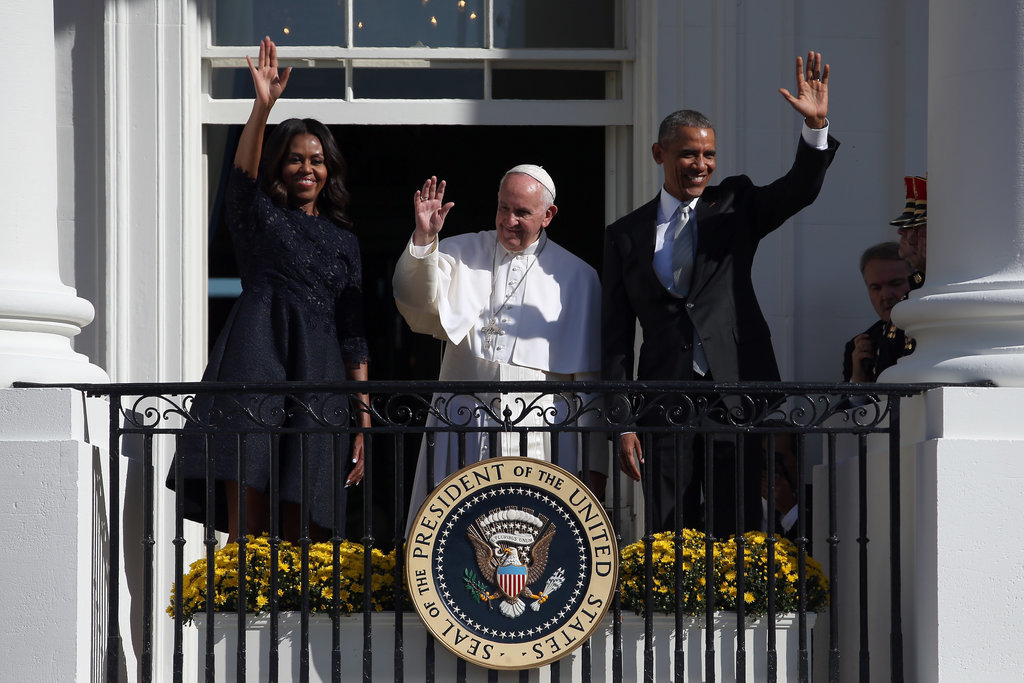
The last couple of weeks have been a tornado of arguments around the Globe, especially for America, from the Republican Party presidential debate to teen Ahmed Mohamed going to Jail for showcasing his homemade clock. On Tuesday afternoon, Pope Francis landed on American Soil. This marks a historic moment for the United State because no other pope has visited the United States since 1965. Perhaps his timing is appropriate; though the US has given him the warmest welcome Pope Francis is ready to create uncomfortable moments (as he should) by bringing light to controversial modern day issues.
The pontiff received the media’s attention with his blunt comments - not only has he condemned capitalism and imposing inequalities for the poor but he also has blunt critiques for society, global economics, and other national topics.

Yesterday afternoon the pontiff directed a speech to the Senate and the House of Representatives and surprised many with his choice of topic. Francis is different from other popes; he introduces himself as a “son of inmigrants” from which America was built.

The pope started his speech with a controversial statement. He challenged congress to see immigration as a moral issue rather than a political issue, that instead of treating people as numbers they should be treated as people. "Do not be afraid to welcome them... I am certain that, as so often in the past, these people will enrich America and its church" he stated in his speech by making the argument that America was once a country full of foreigners which made the Country we are today.  His thoughts on immigration come in an appropriate time, just very recently the republican presidential candidate Donald Trump made strong accusations in regards to immigration against Mexico by stating that if elected he will build an impenetrable wall across the border. But what  people say? 51-year-old Maria Lira made the journey to D.C. from Pennsylvania where she traveled to make a statement for the undocumented. She believes that the pope is the voice of the community because he addresses issues that everyone wants to raise.

Next, Pope Francis addressed climate change. He proclaimed that we need to take immediate action and we cannot pass this problem to the next general. Furthermore, he stressed that America has a duty to act now and advocated that we need to lead that movement. Similar issues have been brought up before but it seems like GOP is slightly more interested in what really matters in this country, the money, just recently they challenged president Obama in regards his plan to cut carbon emissions from power plants because it would hurt the economy and the improvement to the environment would be minimal. Would this plan be effective? I am not sure but what I do know is that it would immoral and illogical to forget to protect and maintain human life at any given time, and that includes our planet.

Francis also urged Cuba and the United States to reconnect after more than half a century of tension. He remained positive during his speech because “the dream continues to inspire us all” every day we wake up in America, although Pope Francis advocated many changes, I am quite unsure on how proactive we are with Cuba. Can we finally rebuild ties? Only time will tell.

The pope is charismatic and people agree with his ideas. Dolores Reyes, a community resident, waited hours to see him. Reyes stated “He is more humble, more connected with people, with everyone. He is a great Pope. I love his approach."


Though the pope has left, his arguments still ring. We should endeavor to practice individualism and self-reliance to see in order to move forward. Global Climate and immigration, the main issues he addressed will require everyone’s participation. Until next time Pope Francis.

Friday, September 18, 2015

Ta-Nehisi Coates- The intellectual pioneer


The word "public intellectual" may be a little obscure for most people in America. Our overwhelming society is filled with virtual "garbage", and we are often fed the news we want to hear. It almost seems like the public intellectual is this mystical creature filled with knowledge. In fact, even if we name many famous intellectuals like Malcolm Gladwell (one of the best writers of our current times), people outside the academic world would be unaware of his work and the current issues happening in our country. Thus, it is necessary to define what a public intellectual is before we move forward.

An intellectual is someone who makes others think. They criticize, pose different views, and suggest alternative solutions to the current issues in our communities. A public intellectual could be almost anybody; their sole purpose is to transform the issue into an argument to allow the community to engage, even if this means they'll receive a lot of negative views.

John Donatich commented on the decline of these individuals on his panel discussion in 2001. He stressed the lack of impact from intellectuals are making lives of the common citizen. Moreover, he judges America for their "anti-intellectualism" and the lack of participation in public speaking, self-reliance and individualism.

Professor Mack, a scholar from the University of Southern California argues the following

As to what Donatich derisively calls a “headstrong individualism and the myth of self-reliance,” it’s worth noting that he’s not giving us full-fledged descriptions of real political ideas but caricatures of an imagined psycho-cultural disposition. An “immature” disposition, at that. One can almost hear the sit-com dad railing against his willful, stubborn, impetuous kid who has once again gotten himself in trouble because he refused to heed Pop’s unwaveringly wise advice. And in this myth, common-folk (like kids) always get into trouble because they lack what all paternal intellectuals have by birthright—impulse control. The infantile common-folk who comprise the “mob” has been the star of elitist melodrama for centuries; they’re also “exhibit A” in nearly every hand-wringing, anti-democratic treatise in the western tradition. Now, are some people ill-equipped for self-government? Of course. But the strongest alternative argument, the best argument for democracy, is not that the people are “naturally” equipped for self-government—but that they need to become so, and, moreover, experience is the only teacher. So here’s the point: Any argument for the public intellectual that, like Donatich’s, rests the assumption that common citizens are forever childlike and must be led by a class of experts is politically corrosive and historically dangerous.

 Mack makes a strong argument by saying that we are looking at this all wrong. He stresses that instead of figuring out who qualifies as a public intellectual, we should be looking at the work public intellectuals are producing and engage in their conversations. Public intellectuals are there to be the "pot boiler" as he calls them. Mack's argument is valid. In fact, no major work has been done for African American rights since the 90's, despite the daily battle that many African Americans face. It was not until Ta-Nehisi Coates came along as a voice for the unspoken with his work at the New York Times and The Atlantic.

Ta-Nehisi is a National Correspondent for The Atlantic. He writes about several topics that array from cultural, social and political issues. Furthermore, he seems particularly interested in the life of African Americans in today’s society. He serves us as a different perspective of history, such as the mistakes and social policies from the past as well as current issues happening in our society. Coates reminds us of the shame and fallacy of equality that America portrays. A society where kids have little social support and are limited to live a errorless life. Making it seen that in order to make it out of poverty, African Americans need to be some kind of super humans to leave their social class. It takes all the personal attributes and skill sets to be successful. We need people like Coates, not only because of his controversial work but because he himself has been a clear example of overcoming racism during his adolescence and childhood.

Coates was Born in Baltimore, Maryland. His father was William Paul Coates, a Vietnam War veteran, former Black Panther, publisher and librarian. His mom Cheryl Waters-Hassan was a teacher. William was one of the leaders of the Black Panthers and he strongly believed in free love and disagreed with monogamy. As a result, William Coates had seven children’s with four different women. This however, did not affect the relationship between Ta-Nehisi and his father. The children lived with their mothers, but they were visited by William on a regular basis he mentioned that he and his father lived together most of the time. This unorthodox way of parenting was geared towards self-development and education from an early age.

Coates passion for books began early. His mom would make him write essays as punishment for bad behavior. More importantly, his dad would often take him to visit Eddie Conway, who was the Minister of Defense of the Baltimore chapter of the Black Panther Party; this clearly had a huge impact in Ta-Nehisi's life. He was able to see the “face of the enemy” as his dad argued when asked why he would take Ta-Nehisi to Jails.

His childhood and adolescence was marked by chaos, but he found himself at peace within this chaos, realizing that this is something he was going to deal as he continued to grow. He recalls a time in his childhood where his mom sat him down and told him what to wear, who to walk to school with, how many people he should walk with. That signaled confusion at the time, he argues. In addition, Coates struggled to remain focused in school (he later wrote a blog about that spoke about the education system in America) so he spent most of the time in the library teaching himself in order to graduate.

After high school, he attended Howard University to study Journalism. He stayed at Howard for five years and eventually left to start his career as a journalist without obtaining his degree. From 2000-2007 he managed to stay relevant and worked for several publications such as the Philadelphia Weekly, The Village Voice, and Time. But it was not until he published “How We Lost to the White Man” that Coates got major exposure. He wrote his post based off a speech given by Bill Cosby (known as the pound cake speech) in May 2004. He targets subsets of the black community for usage of African American Vernacular English, or less precisely Black English as well as the frivolous life that many live despite their economic status. More importantly, Coates argues that racism in America is omnipresent and the community should strive to change that continuously. Furthermore, he suggests that the notion of equality is a little farfetched and misleading due to the current social policies put in place by the United States of America. Instead, he suggest, the Negro community should start by changing their culture, and reclaim traditions that were lost in the past due to violence and racism. This eloquent work gave Coates a position as a senior editor at The Atlantic, a blog that engages a high level of community engagement.

Coates work didn’t stop there nor did he limit his work dealing with African American injustice. Since 2012 he has written influential works such as  “The Fear of a Black President”, “The Case of Reparations”, “Between the World and Me” to name a few. His work has become so impactful that many in the academic world often suggest Coates work should be required reading for today’s society.

Ta-Nehisi shows willingness to put his reputation on the line when important issues are being overlooked. For example, in the post “Fear of a Black President”, Coates (who seemed to be writing with a taste of anger) criticized the position president Obama takes when racial issues arise.  Coates writes

“...The irony of Barack Obama is this: he has become the most successful black politician in American history by avoiding the radioactive racial issues of yesteryear, by being “clean” --as Joe Biden once labeled him—and yet his indelible blackness irradiates everything he touches,"
Coates argues that the president has the tendency to emphasize that he is the president of America with issues that deal with moralities that link minorities in which he has no right to deliver since the basis of America is founded in the vast majority of its history and history is based on a policy of plunder against black people. He later, ends the blog by saying that he shares compassion to Obama and he acknowledges that the president is not a king and that he knows how institutionalized our current government is.

He is a very interesting character if you ask me. He not only put himself in a position to lose popularity but he also makes an extra effort to spread his ideologies to future generations. A clear example is his latest book "Between the World and Me" where he talks about how his child is reading the Ferguson case and the impact that it made. He starts the book by stating "Here is what I would like for you to know: In America, it is traditional to destroy the black body—it is heritage." He claims that it is simply a statement of fact that needs to be understood. He knows that racism is an ongoing fear for young African Americans and that he may very well die without seeing much progress. But that it is an endeavor one must continue to achieve progression.


The controversial Coates is doing exactly what Mack argues in his article, which is “prod, poke, and pester the powerful institutions.” Not only does he discuss the problems in a way that common readers are able to understand and engage, but he also makes plausible and tangential points in regards to possible solutions to the given situation at hand. Fortunately, he is able to share his ideas on a major scale which enables him to make an impact.  To finish Mack hit the nail on the head when he said “The measure of public intellectual work is not whether the people are listening, but whether they’re hearing things worth talking about.”